From Kuala Lumpur to Yerevan: October’s road to COP17
12/10/2026
Dear Planetary Steward,
This is an important month for the global commons, in the lead up to Yerevan, Armenia, where CBD COP17 will hold the first global review of progress on the Kunming-Montreal Global Biodiversity Framework. Here we will find out if countries are on track to halt and reverse nature loss by 2030 – and whether the money is there to make it happen.
The latest science shows what is at stake. This week’s 10 New Insights in Climate Science report warns that the world’s land is drying out, as soils, rivers and groundwater lose fresh water, threatening ecosystems and food production. It also finds that the true economic cost of carbon has been severely underestimated. It follows the Planetary Health Check 2026, launched at Climate Week NYC, which reveals that seven of nine planetary boundaries have now been crossed. Among them is biosphere integrity – the health of the living world – which is the very thing COP17 aims to protect.
What happens in Yerevan will help decide whether, and how, we return to a safe operating space, and so will the momentum leading up to it. One key stop on the road is the Global Tipping Points Conference in Malaysia, the first held in Asia. With Southeast Asia on the front line of planetary change, the Conference connects planetary health to human health, culture and faith. “Together, scientists, policymakers, business leaders, civil society, Indigenous voices, artists, and youth will unite to spotlight South and Southeast Asia’s lived realities and accelerate the positive tipping points we need for a healthier planet and future,” says Conference Co-Chair and member of the GCA’s Expert Council, Prof Tan Sri Dr Jemilah Mahmood of the Sunway Centre for Planetary Health. But ambition is only as good as its funding. In the same week, finance ministers meet in Bangkok for the IMF–World Bank Annual Meetings, where conversations on resilience and the economy will influence how much finance can flow to nature.
At this week’s Berlin Climate Security Conference, the EU’s Special Envoy for Climate and Environment, Anthony Agotha, warned that climate action, economic policy and defence can no longer be treated in isolation. Drawing on the UK’s national security assessment on global ecosystems, Defra’s Carol Vaughan added that nature loss is not a separate environmental risk, as it underpins our societies and economies.
Nature’s decline is also a health crisis, and next week’s World Health Summit in Berlin puts the environmental drivers of health on its agenda. Also in Germany the same week, we will be at New Economies x Bonn, convened by Partners for a New Economy (P4NE). Here funders, researchers and movement leaders will explore how new economic ideas can counter rising inequality, authoritarianism and ecological breakdown. Both gatherings reflect a shift COP17 depends on: we must build systems that serve people and nature today, and leave a thriving planet for future generations to enjoy.
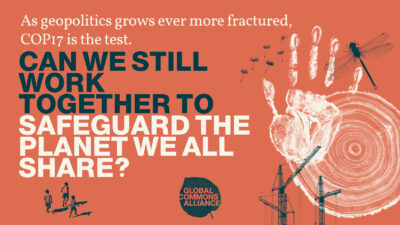
Under the theme ‘Taking Action for Nature’, COP17 must turn global promises into measurable national progress. That means closing the biodiversity finance gap, sharing the benefits of genetic resources fairly, and recognizing the leadership of Indigenous Peoples and local communities. As geopolitics around the world grows ever more fractured, COP17 will be a real test of whether we can truly work together for the global commons.
Members and partners of the Alliance will be at Yerevan making the case for a just world on a safe planet. Until then, we hope to see some of you in Bonn next week. Let’s make this month count.
With all our best, Sebastian Schienle, Co-Director (Partnerships and Programs)
Will Tucker, Co-Director (Communications and Resource Mobilization)
Subscribe now on email or Linkedin and read the rest of our bi-weekly newsletter, including news from across the Alliance.