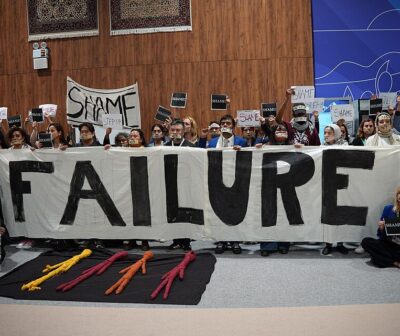
COP31 outcome: Was the Antalya climate summit really a failure?
24/11/2026
By Sebastian Schienle, Co-Director (Partnerships and Programs), Global Commons Alliance.
COP31 ended without an agreed outcome and is described as a failure. Is that the whole story?
After two days of overtime, the Antalya Pact was not adopted. In a year of devastating climate impacts – from Nepal’s glacier collapse to the deadly heatwave in Europe to wildfires across the globe – and at a COP that recognizes 1.5°C as out of reach, that is heartbreaking. There’s no way around it.
But maybe that final breakdown of consensus also points to something stronger.
The final text recalled the COP28 agreement without naming fossil fuels at all. Around 130 countries, including the EU, the UK, and many of the most vulnerable small islands and least developed countries, came together to demand that the transition away from fossil fuels be named. Their demand failed, and the pact fell with it.
Is it possible that this is less a failure of multilateralism than a sign of its changing shape? A large group of countries declined to settle for the lowest common denominator at a moment when that denominator clearly doesn’t meet the urgency and scale of the challenge.
Outside the negotiating rooms, momentum is building. The Action Agenda is moving. The process on the Just Transition Away from Fossil Fuels that began in Santa Marta in April is accelerating. Coalitions of the willing may be where the pace gets set now, with countries working together to advance the agenda rather than letting a few bring the system to a halt.
This isn’t to gloss over the challenges – funding is insufficient and progress is much too slow (or even going backwards) including in places like the EU that rejected the pact. But the COP’s failure does point to a recognition that “business as usual” in the multilateral process is insufficient.
So how do we build on that to mobilize more urgent action and momentum towards a just world on a safe planet?
How the GCA is driving action
Building public and political momentum
- United for the Future – We Don’t Have Time and Researchers’ Desk: aims to mobilize 100 million people for climate action on 15 September 2028.
- Planetary Peace Partnership – Climate Bridges and the Club of Rome: next steps are the Leadership Gathering in Caux in March 2027 and the Planetary Peace Summit & Forum in Geneva in June 2027.
Strengthening Earth governance
- Climate Governance Commission and MEGA: developing dedicated workstreams on a Global Earth System Policy Innovation Hub, an Earth system foresight and rapid response platform, and an International Environmental Court. Dialogues with finance and industry leaders are also continuing.
Advancing the science
- Future Earth: the Global Carbon Budget 2026 and the 10 New Insights in Climate Science, which were both presented at COP31.
- Earth Commission: continuing to work on transformation pathways toward a safe and just space.
- Adaptation Futures 2028 – EcoCitizen with UNEP’s World Adaptation Science Programme: the conference takes place in Cancún in 2028.
Mobilizing business
- Science Based Targets Network: more than 150 companies are preparing science-based targets for nature.
- We Mean Business Coalition, with partners including The B Team: more than 180 companies have signed the Seizing the Electric Advantage statement.
These are just some examples of the many important initiatives underway from GCA members. Keep an eye on our Linkedin and newsletter for more in the new year, and join us to be part of the movement.
–
Photo: “COP31 – Protests 11” by Xuthoria, licensed under CC BY-SA 4.0 (https://creativecommons.org/licenses/by-sa/4.0/), via Wikimedia Commons: https://commons.wikimedia.org/wiki/File:COP31_-_Protests_11.jpg