COP31’s final day: what to watch and what comes next
19/11/2026
Dear Planetary Steward,
In Turkish villages, imece is the tradition of neighbours coming together to do what no household could manage alone, whether that’s bringing in a harvest, fixing a roof or clearing a road. Fittingly, today is İmece Day at COP31, dedicated to enhancing implementation, as negotiators in Antalya head into the final day of talks. But implementation can’t be left to COP alone. While multilateral deals set the direction, delivery depends on treating climate, nature and justice as aspects of an interconnected system, and on turning pledges into accountable action that keeps humanity within a safe and just space.
That starts with hardwiring science into international action, and the science that opened the summit was bleak. The World Meteorological Organization’s State of the Climate Update, released on the first day, found that global temperatures from January to September 2026 averaged about 1.47°C above pre-industrial levels. It also found that 2015 to 2026 are set to be the 12 warmest years on record. A strengthening El Niño will likely bring more extreme heat, drought and flooding into 2027. To explore how we can avoid dangerous tipping points and manage overshoot, watch the recording of the COP31 science update session which was hosted by Future Earth, UNFCCC and Potsdam Institute for Climate Impact Research earlier this week. Moderated by GCA Expert Council member Hindou Oumarou Ibrahim, the session brought scientists including Johan Rockström together with ministers to discuss how science can better shape real-world decisions.
After a first week slowed by transport and accreditation delays, which left many delegates stuck outside the venue or working from hotel rooms, the negotiations have centered on the cover decision. The first draft, published on Monday, proposes raising adaptation finance to at least $120 billion by 2035, and includes language both on transitioning away from fossil fuels and on phasing them out, though either could still be cut. It also acknowledges that warming is projected to exceed 1.5°C and calls for a return below it as early as possible. As we send this email, ministers remain deadlocked on more than 20 issues, including finance and the new Just Transition Mechanism, with a revised draft expected later today.
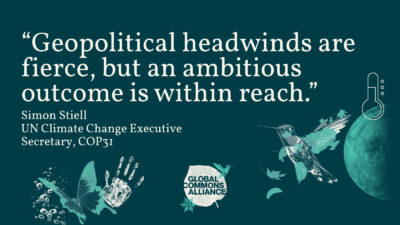
Still, UN Climate Change Executive Secretary Simon Stiell insists that while “geopolitical headwinds are fierce”, an “ambitious outcome is within reach”.
Elsewhere, Türkiye’s ‘35 by 35‘ pledge to raise electricity to 35% of global energy use by 2035 has gained 75 backers. While there is a draft text, debates persist over whether that power must be clean. Meanwhile, countries have agreed to continue the Mitigation Work Programme, but are still negotiating its scope, with small island states pushing to keep 1.5°C within reach. On nature, oceans feature prominently in the draft deal alongside over $30 million in new coral reef funding, a 23-nation Indigenous-backed wildfire plan, and Ghana securing Africa’s first high-integrity forest carbon credits. Frustratingly though, formal talks to align the three UN Rio Conventions, which would treat climate, nature and land as the interconnected system they are, were pushed to 2027.
As the talks close, the question Earth4All’s Sandrine Dixson-Declève raised during COP’s opening days still stands: will this be “another COP where ambition is not matched by action”? She argued it should confront fossil fuel subsidies and treat climate as a security issue.
The talks are due to close tomorrow, Friday 20 November, though observers expect them to run at least one extra night. In the final hours, watch for compromises on fossil fuels, adaptation finance and 1.5°C overshoot, and for what they signal for national transition plans and the second global stocktake, launched this week and due to conclude in 2028.
Whatever the final text says, the lesson of imece still matters. Planetary challenges are shared by all of us, and only a shared effort will meet them. That collective spirit is exactly how GCA members and partners showed up in Antalya, and you can read about their work below.
With all our best,
Will Tucker, Co-Director (Communications and Resource Mobilization)
Sebastian Schienle, Co-Director (Partnerships and Programs)
Subscribe now on email or Linkedin and read the rest of our bi-weekly newsletter, including news from across the Alliance.