WEF: As Trump denies science, leaders call for planetary prosperity
21/01/2026
Today at the World Economic Forum (WEF) in Davos – shortly before President Trump presented his vision of a future marked by science denial – another vision was shared with the world.
In sharp contrast to President Trump’s vision, leading global voices representing science, business, civil society and the majority world delivered a speech outlining a future of prosperity within planetary boundaries – calling for a rapid transition to a global economy that serves both people and the planet.
In his keynote address the same afternoon, President Trump presented an aggressive vision of a fossil-fuelled world economy that will destroy the environment, equity and security around the world. Boasting of oil investment growth in the US, he called the global clean energy transition a “green new scam”. He stated – incorrectly – that windmills lose money and that China only exports them while preferring fossil fuels for their own energy generation In fact, renewable energy projects, including wind, are now cheaper than fossil fuel alternatives in most cases, and China is home to almost half of the world’s installed wind turbine capacity.
In the alternative speech, Sandrine Dixson-Decleve, Executive Chair, Earth4All proposed that prosperity within planetary boundaries is the only real path to resilient economies. “[President Trump’s] vision is grounded in fossil-fuel driven expansion and deregulation. It hordes prosperity for the few and is contributing to a world that is less safe, and less stable for the majority. [..] [Our vision] redefines prosperity and regards a stable planet as our only choice for survival but also as a lasting opportunity for security and for peace and for prosperity for all.”
Economic costs
While President Trump asserted his belief that fossil fuels are the only route to prosperity, Sandrine explained the costly impacts of extractive economies as well as the economic benefits of climate action: “Every year the damage from climate and nature continue to draw trillions from the global economy, money that could instead lift millions out of poverty. […] Just investing 1-2% of global GDP in climate and nature restoration could yield ten times that value in economic and social returns.”
Some countries may follow the outdated fossil-fuelled model of economic growth, but Sandrine stressed that many are abandoning these failed systems: “More countries today are putting wellbeing and ecological resilience at the heart of their economies. And we know what works.”
Elaborating from a business perspective, Paul Polman, co-founder of IMAGINE and former CEO of Unilever, explained that protecting nature does not come at the expense of economic growth: “Nature is not separate from the economy. It sits at its heart. It determines whether a business can operate at all. Whether supply chains hold. Whether communities are stable. And whether growth can be sustained over time.” He outlined how factories, data centers, farming and manufacturing all depend on healthy soils, water and forests. “When that stability breaks down the impacts are not abstract. They show up as higher prices, broken supply chains, lost livelihoods, bankrupt companies and people forced to leave their homes.”
While President Trump said Europe is facing the “consequences” of its economic and energy choices and that the green energy “hoax” only loses money, Paul Polman affirmed: “When it comes to nature, retreat is the riskiest choice that a business can make.”
Opportunity to act
Countering the climate denial President Trump is known for, Johan Rockström, Co-chair, Earth Commission, Director, Potsdam Institute Climate Impact Research, stressed the implications of ignoring Earth system science: “This choice of a future that is a dead end or a future that can provide prosperity and equity matters because the science today is unequivocal. We are today at risk of destabilizing the entire planet.”
Yet even though the opportunity to act diminishes with each moment we delay, Johan asserted that there is still time to work together to change our trajectory. “The economic costs would be staggering. Coastal cities lost. Health systems overwhelmed. Entire sectors destabilized. But there is still a window which is open. The chance is here if we act now to bring human activity back within the safe and just operating space of planetary boundaries. Of a stable and resilient planet. This requires rapid transformation of our food, energy, transport and industrial systems, starting with the full scale phase out of fossil fuels now with zero carbon economy within the next 25 years.” He concluded: “The leaders here in Davos have the power and the responsibility to change course and to lead the transformation that the world so urgently needs.”
Closing the speech, Carlos Nobre, Senior Scientist, University of São Paulo and Co-Chair of the Science Panel for the Amazon reiterated the importance of an equitable transition away from extractive economies: “Wealth is concentrated at the top. This is not an accident. It is the result of a flawed economic model and misguided notion of prosperity. [..] “We call on leaders here in Davos to champion prosperity rooted in human dignity, equity and ecological resilience, anchored in a new model of international cooperation.”
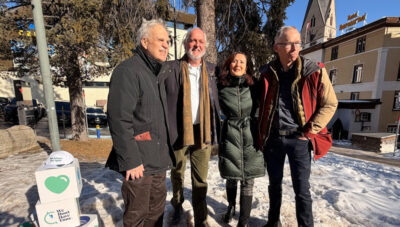
Organized by Earth4All, Earth Commission, Planetary Guardians and the Global Commons Alliance, We Don’t Have Time broadcast the address from Davos shortly before President Trump’s speech.