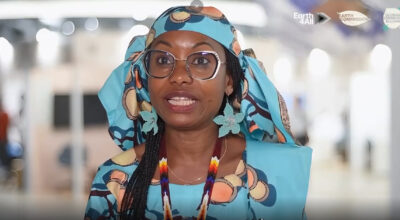
Video: Collective wisdom for a safe and just world
19/12/2025
Can we build a future that is safe and just for all people? This video captures collective wisdom from experts across traditional silos — including science and Indigenous knowledge to economics and policy — following discussions which took place at COP30 in Belém, Brazil, organized by Earth4All, Earth Commission, and Global Commons Alliance.
As Earth system science makes clear, we’re approaching dangerous thresholds. As Tim Lenton, Earth Commissioner and Director of the Global Systems Institute, University of Exeter and Chair in Climate Change and Earth System Science, explains in the video: “A tipping point is where a little change makes a big difference to a system. [..] And it’s very hard to reverse. If we carry on global warming to the level that current policies would take us, like 2.5 or 3C of warming, then over 2 billion people will be put into unprecedented hot conditions, potentially life threatening.”
Transformation is urgently needed in our economic systems to counteract this trajectory. For too long, finance and development have operated on an extractive basis that treats nature as an endless resource to be consumed. But Laura Pereira, Professor of Sustainability, Wits University, and Earth Commissioner, suggests that a fundamental shift is underway. “I think a really interesting ongoing process of transformation that we’ve started to see is where we’re moving finance from being nature eroding, [..] into economic, systems that are, are fundamentally thriving in harmony with nature.”
Watch video
This transition requires more than incremental change — it demands reimagining how we value prosperity, growth, and success. Sandrine Dixson-Declève, Executive Chair, Earth4All explains how this challenge transcends economics: “We need to go beyond just an extractive economy and bring in the values of people and humanity through new indicators. But we need to translate that now at the regional level, at the local level.”
All experts interviewed agree that we cannot achieve safety without justice for all humans. The two are fundamentally interconnected. Fatima Denton, Co-chair of the Earth Commission and Director of the African Climate Policy Centre affirms: “We can’t understand safety without understanding justice. As I said, justice and inequality are stabilizing forces.”
This means moving beyond technical solutions to address the root causes of vulnerability and marginalization. It means recognizing that true security comes from equity, not control. Central to this approach is the democratization of knowledge, which Fatima Denton explains as “making sure that we count different types of knowledge, not just scientific knowledge, but Indigenous knowledge”.
Indigenous wisdom
This inclusive approach respects the wisdom of those who have lived in harmony with their environments for generations and offers crucial insights for our collective future. Hindou Oumarou Ibrahim, Member of the United Nations Permanent Forum on Indigenous Issues, and President AFPAT highlights that for Indigenous peoples, the boundaries we’ve artificially created between ecosystems and human systems, simply don’t exist. “For us, everything is interconnected. You cannot tackle one and leave the others.”
This holistic perspective offers perhaps our most valuable lesson for the future. The siloed approach that has dominated environmental and policy thinking for decades has failed us precisely because it ignores these fundamental connections. Climate change, biodiversity loss, and social injustice are not separate issues — they are symptoms of the same broken system.
Ilona Szabó de Carvalho, Co-founder and President of the Igarapé Institute states: “Nature is just absolutely fundamental for our wellbeing and for our economies. There’s no us without nature.”
Pathways forward
The discussions captured at COP30 illuminated pathways forward. The Earth Commission’s Safe and Just framework, combined with Earth4All’s System Dynamics Modeling, provides the tools we need to navigate this complex transition.
But what emerged most clearly is that we need integrated, systems-based approaches that address climate and nature risks while amplifying justice and stability across borders, sectors, and generations.
Mary Robinson, Planetary Guardian, Founding member of The Elders and Adjunct Professor for Climate Justice in Trinity College Dublin; former President of Ireland and former UN High Commissioner for Human Rights, and co-founder said: “We need systems change. I really believe that. And we need to understand that the political system is holding us back, because it’s not recognizing that we need to move very rapidly to a just and equitable world, and just, equitable transition as rapidly as possible.”
This gathering of collective wisdom merged science, justice, and systems thinking. The science tells us what we must do; the wisdom of Indigenous peoples shows us how to think; and the imperative of justice gives us the moral foundation and urgency to act. There is no doubt that we need all three working together in order to secure a safe and just world for every single life on Earth right now, and far into the future.
Follow us on Linkedin where we will share the rest of this video series with each of the above featured speakers.